Free · 10 questions · all 4 sections · no sign-up
Free DAT practice questions
A taste of every section - Natural Sciences, Perceptual Ability, Reading and Quantitative - written the way the real test asks. Pick an answer, then check it. A fresh mix every visit.
SNS
Survey of the Natural Sciences
100 questions in 90 minutes: Biology, General Chemistry and Organic Chemistry.
Question 1 · Biology
In pea plants, tall (T) is dominant to short (t). Two Tt plants are crossed. What fraction of the TALL offspring are expected to be heterozygous?
Question 2 · General Chemistry
How many grams of NaOH (molar mass 40.0 g/mol) are needed to make 250. mL of a 0.200 M solution?
Question 3 · Organic Chemistry
Which reagent oxidizes a primary alcohol to an aldehyde without carrying it on to the carboxylic acid?
PAT
Perceptual Ability
90 questions in 60 minutes across six visual subtests. Nothing to memorise - only practice moves it.
Question 1 · Cube Counting
How many cubes have exactly 2 of their sides painted?
All exposed faces are painted, including undersides above a gap. Faces touching the table or another cube are unpainted.
QUESTION 1 OF 3 ON THIS FIGURE
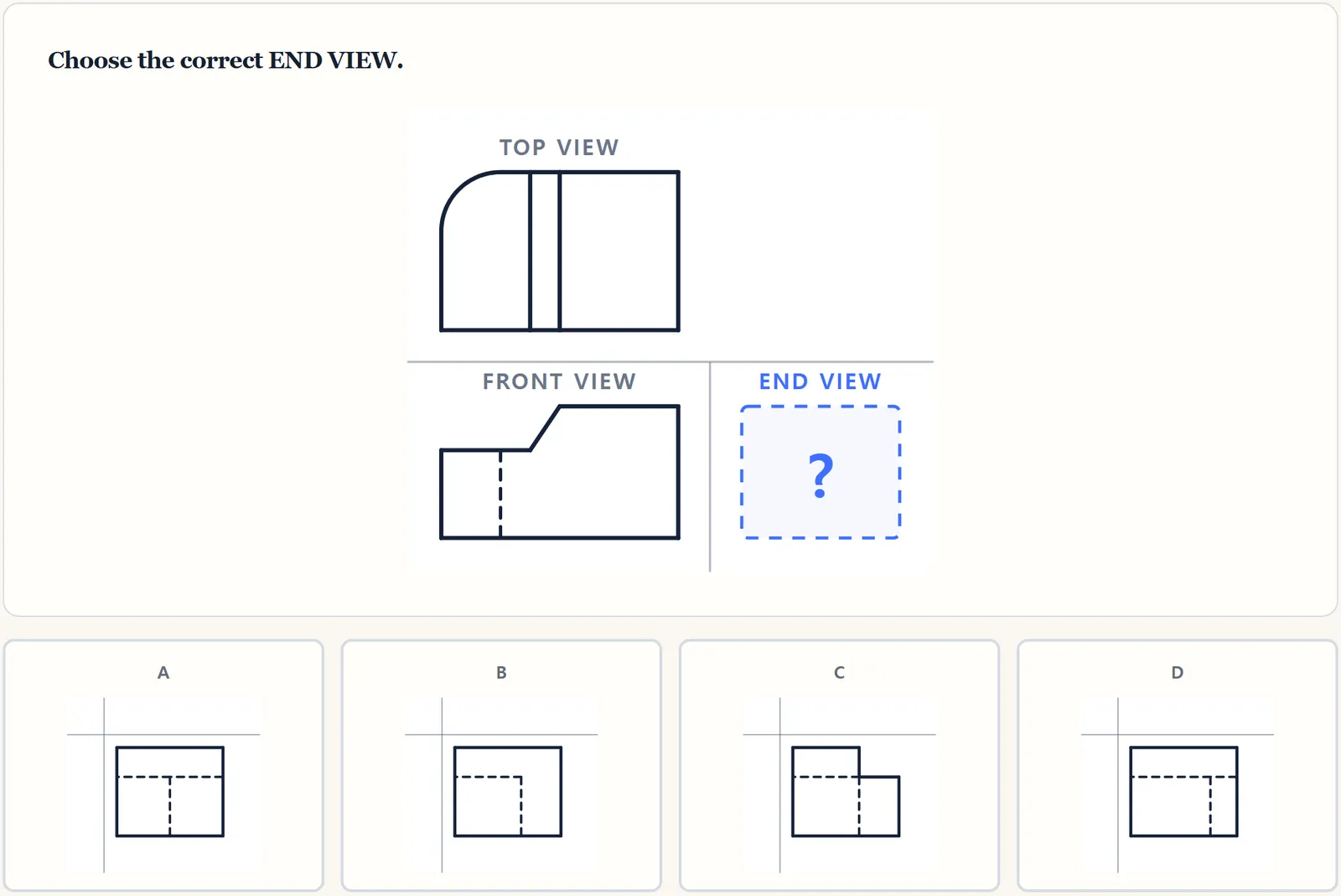
Question 2 · Top-Front-End
Choose the correct TOP VIEW.
Question 3 · Pattern Folding
Which solid can be folded from this pattern?
RC
Reading Comprehension
Three science passages, 50 questions in 60 minutes. Every answer is in the text.
Read the passage: Surviving Without Water
Tardigrades, the eight-legged micro-animals often called water bears, are less than a millimetre long, yet some species survive being dried almost completely. As their surroundings dry out they pull in their legs, lose most of their body water and contract into a shrivelled form known as a tun. In this state metabolism becomes nearly undetectable, a condition called anhydrobiosis, and the animal can remain dormant for years before reviving within hours of being wetted.
For a long time the leading explanation borrowed from other desiccation-tolerant organisms. Brine shrimp cysts and many plant seeds accumulate the sugar trehalose as they dry. Trehalose is thought to replace water around proteins and membranes and to set into a glass-like solid that holds cell contents in place, so that nothing unfolds or fuses while the organism waits.
Tardigrades complicated that story. Several species that survive drying well make little or no trehalose. Instead, researchers found families of proteins that exist only in tardigrades. These proteins have no fixed shape in solution, but as the cell dries they appear to form a gel and then a glassy matrix, much as trehalose does elsewhere. When the genes for some of these proteins were silenced, the animals survived drying far less often; when the proteins were produced in yeast and bacteria, those microbes became more tolerant of drying.
The finding suggests that evolution has reached the same physical solution, vitrifying the cell, by more than one chemical route. It has also drawn practical interest: proteins that protect cells without refrigeration could one day help store vaccines and other biological medicines.
Question 1 · Surviving Without Water
Which finding most directly challenged the idea that trehalose explains desiccation tolerance in tardigrades?
Question 2 · Surviving Without Water
The gene-silencing and yeast experiments described in the third paragraph serve primarily to:
QR
Quantitative Reasoning
40 questions in 45 minutes with a basic on-screen calculator. Near the top, every miss costs points.
Question 1 · Quantitative comparison
Given x < 0, compare the two quantities. Column A: 5x - 25 Column B: 5(x - 5)
Question 2 · Algebra
If 3 is to 4 as 18 is to x, what is x?
When you are ready
Ten full-length DATs, scored on the 200-600 scale
Every section timed like test day, a worked explanation for every question, missed-question drills, unlimited PAT practice and a study plan built from your test date.
DAT is a registered trademark of the American Dental Association. DAT600 is not affiliated with or endorsed by the ADA.