Section guide · PAT
DAT Perceptual Ability Test (PAT)
90 questions in 60 minutes, in six subtests of 15. Nothing on the PAT is taught in a college course, which is exactly why it moves the most with practice.
How the section is built
90 questions in 60 minutes, about 40 seconds each - the tightest pace on the DAT. The six subtests come in a fixed order: Keyholes (Apertures), Top-Front-End (View Recognition), Angle Ranking (Angle Discrimination), Hole Punching (Paper Folding), Cube Counting (Cube Counting), Pattern Folding (3D Form Development).
All six share one clock. You can move back and forth within the section, so one slow subtest borrows its time from every subtest after it.
What it tests
1. Keyholes (Apertures)
Pick the one opening the solid passes through. Reading a three-dimensional solid as its exact silhouette from each principal axis.
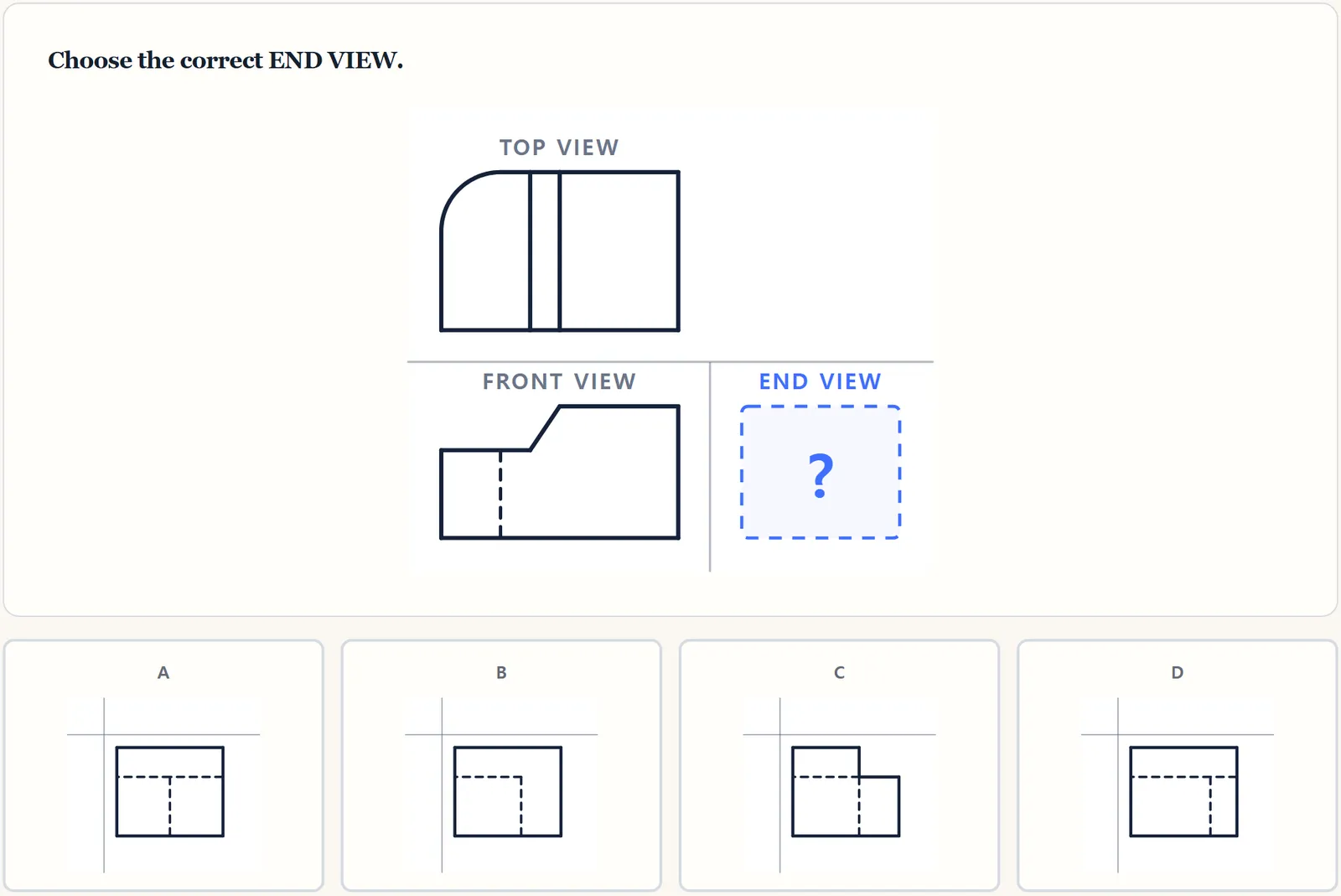
2. Top-Front-End (View Recognition)
Two of the three views are given. Reconstruct the third. Cross-referencing the dimensions the views share and telling hidden edges from visible ones.
3. Angle Ranking (Angle Discrimination)
Rank four angles smallest to largest. Judging small angular differences at the vertex while ignoring ray length.
4. Hole Punching (Paper Folding)
Fold, punch, unfold - where do the holes land? Mirroring punches back across every crease, in reverse order.
5. Cube Counting (Cube Counting)
The stack was painted, then pulled apart. Counting exposed faces in a stack where the bottom and every joint stay unpainted.
6. Pattern Folding (3D Form Development)
Fold the flat pattern. Which solid is it? Tracking face adjacency, opposite faces and mark orientation through a fold.
How to practise it
- 01Learn each subtest's method untimed first. Every subtest has a repeatable procedure, and speed comes from doing that procedure without thinking about it.
- 02Then drill each subtest at the real pace in short daily sessions. Twenty focused minutes a day does more than one long weekend block.
- 03Practise the two procedural subtests - Hole Punching and Cube Counting - until they are close to automatic, so they bank time for Keyholes, Top-Front-End and Pattern Folding.
- 04Once each subtest is steady, sit the whole section at once. The PAT comes straight after the 90-minute science block on test day, so practise it tired as well.
Common mistakes
Ranking angles by ray length
Long rays make an angle look bigger. Only the opening at the vertex counts.
Mirroring in the wrong order
In Hole Punching, unfold the last fold first and mirror one crease at a time. Unfolding in the order the paper was folded puts holes in the wrong place.
Counting the bottom as painted
In Cube Counting the bottom of the stack and every face touching another cube stay unpainted. Keep a tally by number of painted sides as you go.
Ignoring hidden lines
In Top-Front-End a dashed line is an edge you cannot see from that side. Treating it like a solid line points to the wrong view.
Letting one subtest run long
At about 40 seconds a question there is no time to stare. Pick, mark it and come back if time is left at the end.
How it is scored
The PAT is reported as one score on the 200-600 scale for all 90 questions. The ADA reports a first-time mean of about 411 (DAT User's Manual 2026, tests taken March to December 2025).
The PAT is not part of the Academic Average, and dental schools see it as its own line on your score report.
The ADA does not publish the table that turns correct answers into a 200-600 score, so every practice score is an estimate. How DAT600 estimates a score explains ours, and the DAT score calculator turns a raw score into an estimate with its range.
PAT questions
How many questions are on the DAT PAT?
90 questions in 60 minutes, in six subtests of 15.
What are the six PAT subtests?
Keyholes (Apertures), Top-Front-End (View Recognition), Angle Ranking (Angle Discrimination), Hole Punching (Paper Folding), Cube Counting (Cube Counting), Pattern Folding (3D Form Development), in that order.
How much time do I get per PAT question?
About 40 seconds on average, with one clock for the whole section.
Does the PAT count toward the Academic Average?
No. The Academic Average is Biology, General Chemistry, Organic Chemistry, Reading Comprehension and Quantitative Reasoning. The PAT is reported separately.
Can you improve your PAT score with practice?
The PAT tests procedures that are not taught anywhere else, so practice is how students learn them. How much a score moves varies by student.
Other sections
See PAT on the real screen.
Ten free questions across all four sections. No sign-up.