DAT prep guide · updated November 2026
DAT prep with free practice tests
The DAT is 280 questions and 4 h 15 min of section time in one sitting. Content review gets you the knowledge; practice tests get you the pace, the stamina and the screen. Here is where each kind of practice fits in a study plan.
Three kinds of practice, three jobs
Diagnostic
Shows where you start before you open a book. The free DAT600 diagnostic is ten questions across all four sections with every answer explained, so you see the formats and where you stand without a four-hour sitting.
Drills
Short single-section sets with the answer shown as soon as you choose. They fix one weakness at a time: start untimed until the method is reliable, then hold yourself to the real pace.
Full-lengths
All four sections in test-day order on their own clocks, with the optional break after the PAT. The only practice that shows what 4 h 15 min does to your PAT accuracy and reading speed. DAT600 has 10 of them.
Know the clock for each section
Every drill should eventually run at the real pace, so learn it first. Each section has its own guide on how it is built, what it tests and how to practise it.
A week-by-week shape
This is a shape, not a prescription. Stretch it if you are working or the science courses were a while ago, compress it if not, but keep the order: diagnose, learn, drill, then full-lengths.
- Week 1Find your starting pointFree diagnostic, then one timed section of each type. Read each section guide once.
- Weeks 2-4Content review: Biology and General Chemistry firstUntimed drills on each topic as you finish it. Daily short PAT sessions, one subtest at a time.
- Weeks 5-7Content review: Organic Chemistry, QR math, RC methodDrills move to the real pace. One timed RC passage set and one QR set a week.
- Weeks 8-9Full-length phaseA full-length every week, reviewed the next day. Drills only on what the review turns up.
- Weeks 10-11Final two weeksOne or two last full-lengths at your appointment time, then light review of your error log.
Start the PAT and Reading Comprehension early even while science review is the main job. Neither has content to learn from a book, so they only improve with time spent practising them.
How to review a full-length
Leave at least as long for the review as you spent taking the test, and do it before you take the next one.
- 01Go through every question, including the ones you got right by guessing. A lucky right answer is a miss you have not found yet.
- 02For each miss, read the worked explanation and the reason your choice was wrong, then sort it: did not know it, misread it, ran out of time, or changed a right answer.
- 03Log it with the section, topic and reason. One line each is enough.
- 04Turn the log into next week's plan. Content gaps go back to review, misreads and timing go to timed drills, and a subtest that keeps appearing gets a daily slot.
- 05Look at the clock, not only the score. Where in each section did you fall behind, and which questions took twice the average?
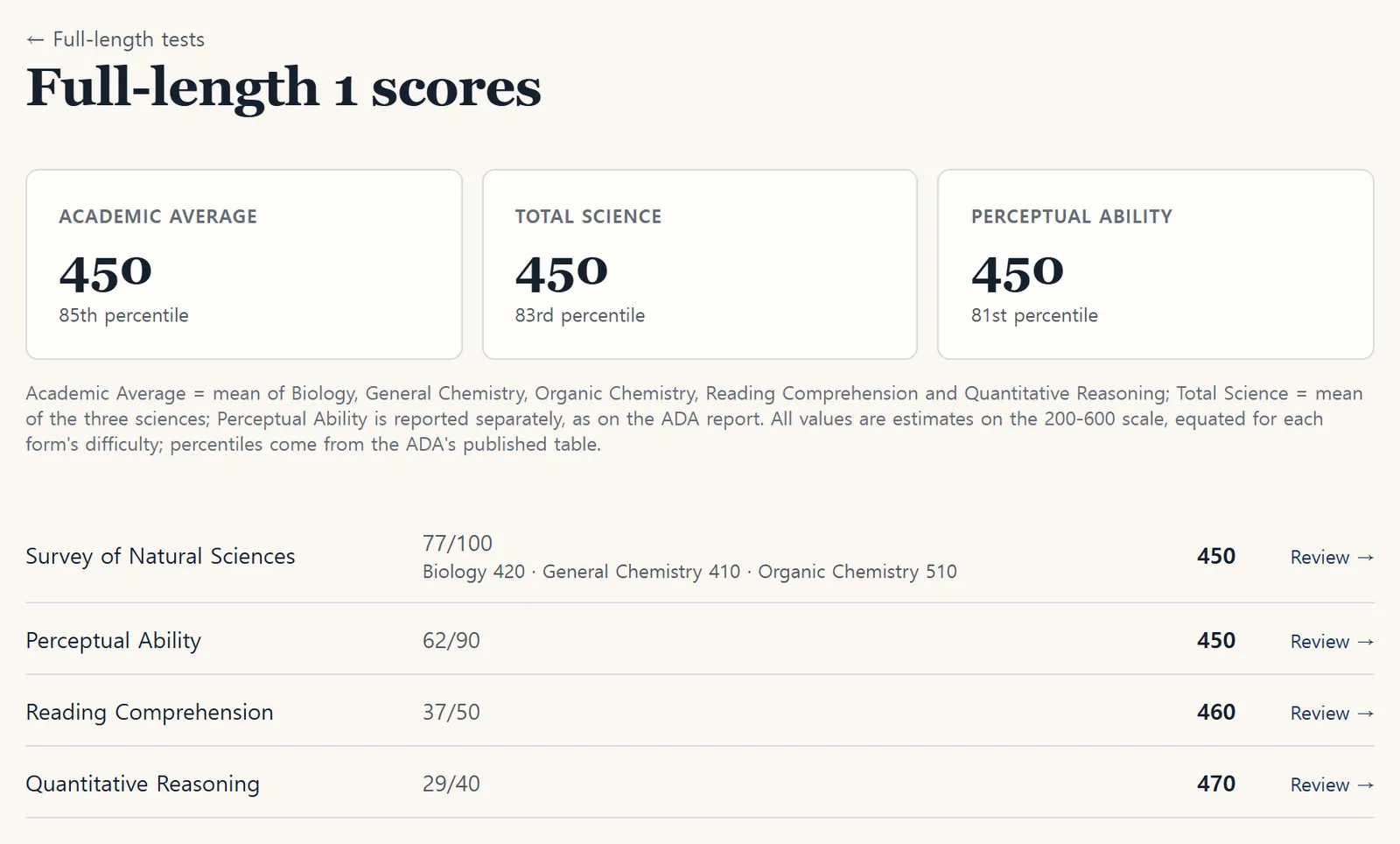
Read the score as a range, and compare first attempts only. Two sittings 20 points apart may be the same performance. To see what a raw score turns into, use the DAT score calculator.
The last two weeks
- Sit your last full-length about a week before test day, at the same time of day as your appointment, with the break taken where the real test allows it.
- Save at least one unseen full-length for these two weeks. A form you have already seen gives a score you cannot trust.
- Stop adding new content in the last few days. Re-read your error log and your notes on each PAT method instead.
- Keep PAT practice short and daily right up to the end; the procedures fade faster than content does.
- Confirm the logistics: your Prometric appointment, the ID you will bring, how long it takes to get there.
- Sleep the night before. A tired brain loses more on the PAT and Reading Comprehension than any last-minute review gains.
DAT prep questions
How long should I study for the DAT?
Many students plan around two to three months of steady study, but it depends on how recently you took the science courses and how many hours a week you have. Use your diagnostic to decide, and keep the order of the phases whatever the length.
When should I take my first DAT full-length?
Take a short diagnostic before you start, and your first full-length once most of the content has been covered at least once. Taking full-lengths too early mostly measures content you have not studied yet.
How many DAT practice tests should I take?
Enough to see a trend across several sittings, each one reviewed before the next. A full-length you do not review is mostly stamina practice.
Are DAT600 practice scores official?
No. They are estimates on the 200-600 scale shown with a range. The ADA does not publish its raw-to-scale table, so every practice score anywhere is an estimate.
Is DAT600 free?
Yes, during the beta. The 10-question diagnostic needs no account; timed sections, drills and full-lengths need a free account.
Week 1 starts here.
Ten free questions across all four sections. No sign-up.
DAT is a registered trademark of the American Dental Association. DAT600 is not affiliated with or endorsed by the ADA.