Section guide · SNS
DAT Survey of Natural Sciences (SNS)
The first and longest section of the DAT: 100 questions in 90 minutes, covering Biology, General Chemistry and Organic Chemistry in one timed block.
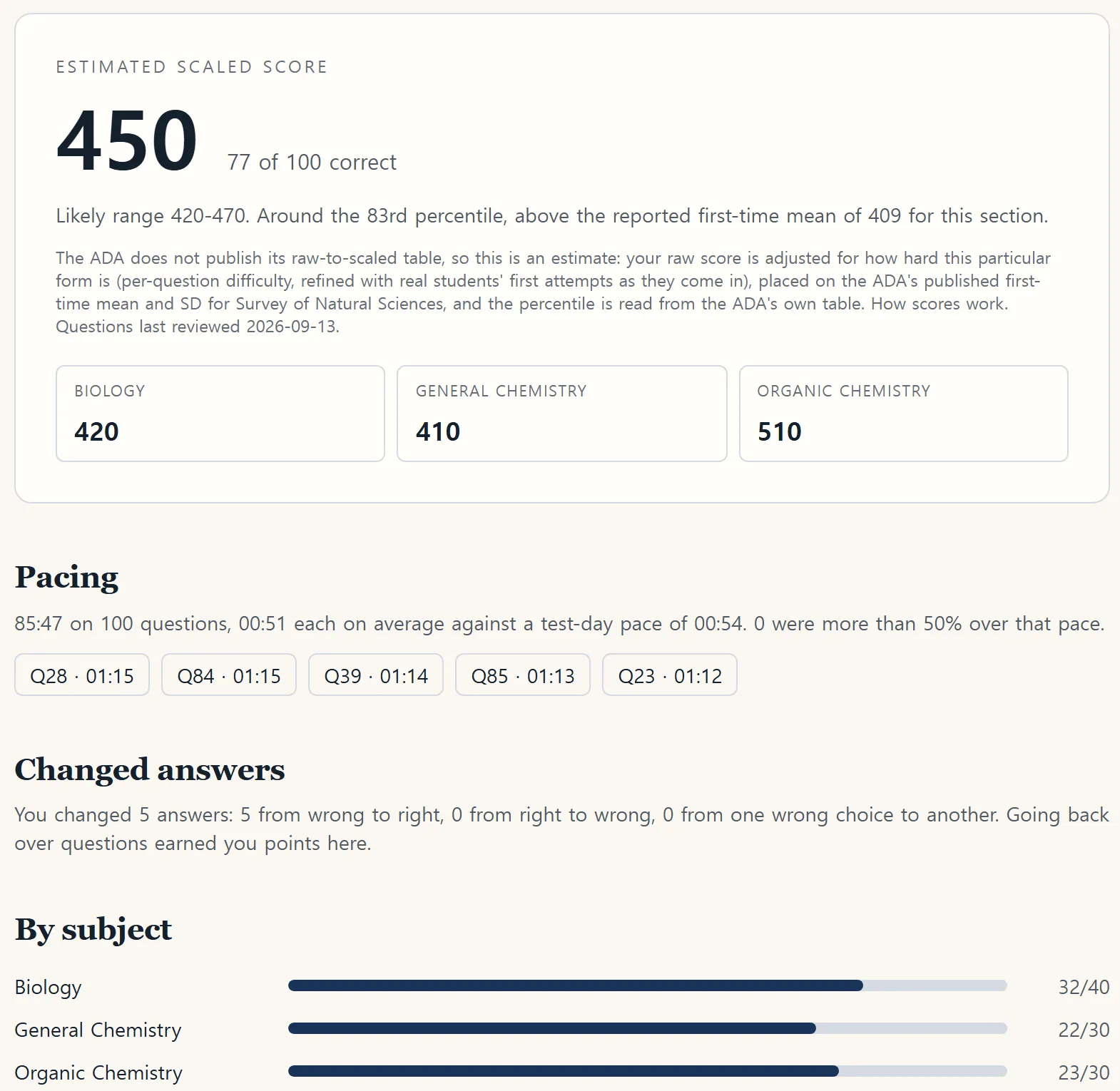
How the section is built
One block of 100 multiple-choice questions in 90 minutes: 40 Biology, 30 General Chemistry, 30 Organic Chemistry. The subjects come in that order and share one clock, so time you save in Biology is time you can spend on a stoichiometry problem later.
That works out to about 54 seconds a question. There are no passages and no calculator; a periodic table is available on screen.
What it tests
Biology
Cell and molecular biology, cellular processes, diversity of life and classification, the structure and function of organ systems, developmental biology, genetics, evolution and ecology. It is the broadest of the three subjects and rewards wide coverage over depth.
General Chemistry
Stoichiometry, gases, liquids and solids, solutions, acids and bases, chemical equilibrium, thermodynamics and thermochemistry, kinetics, oxidation-reduction, atomic and molecular structure, periodic trends and nuclear reactions. Expect arithmetic you do by hand.
Organic Chemistry
Mechanisms and energetics, structure and stereochemistry, nomenclature, individual reactions of the main functional groups, acid-base chemistry, aromaticity, and identifying compounds from spectroscopy and lab techniques.
How to practise it
- 01Review content one subject at a time, but test it mixed. A question bank sorted by chapter tells you what to recall before you read the stem; the real section does not.
- 02After each content block, sit a timed set at the real pace. Note which misses were content you never learned and which were recall you knew but could not reach in time.
- 03Practise General Chemistry arithmetic without a calculator from the start: scientific notation, logs to one decimal place, and rounding before you divide.
- 04For Organic Chemistry, draw mechanisms rather than memorising product lists. Most reaction questions are one arrow-pushing step away from a mechanism you already know.
- 05Once all three subjects are covered, sit the whole section in one go so you learn to move on from a hard Biology question instead of spending the chemistry time on it.
Common mistakes
Spending chemistry time on Biology
Biology comes first and feels familiar, so it is easy to drift past 54 seconds a question and arrive at General Chemistry short of time. Mark and move on.
Over-studying one subject
Biology has the most questions but the widest syllabus. Ten more hours on a topic you know well usually moves the score less than closing a gap in Organic Chemistry.
Calculating to full precision
Answer choices are usually far enough apart that estimation picks the right one. Long division on the scratch board is where minutes go.
Reading the stem too fast
Words like NOT, EXCEPT and LEAST flip the question. Most Natural Sciences misses that feel like content gaps are actually misreads.
How it is scored
The section is reported four ways on the 200-600 scale: Biology, General Chemistry and Organic Chemistry separately, plus Total Science for the section as a whole. Total Science is not a simple average of the three; it comes from all 100 questions together.
The three subject scores also feed the Academic Average with Reading Comprehension and Quantitative Reasoning. For reference, the ADA reports first-time means of about 411 for Biology, 405 for General Chemistry, 410 for Organic Chemistry and 409 for Total Science (DAT User's Manual 2026, tests taken March to December 2025).
The ADA does not publish the table that turns correct answers into a 200-600 score, so every practice score is an estimate. How DAT600 estimates a score explains ours, and the DAT score calculator turns a raw score into an estimate with its range.
SNS questions
How many questions are in the DAT Natural Sciences section?
100 questions in 90 minutes: 40 Biology, 30 General Chemistry, 30 Organic Chemistry.
Is there a calculator in the DAT science section?
No. The calculator is only available in Quantitative Reasoning. A periodic table is available on screen in the Natural Sciences section.
How much time do I get per science question?
About 54 seconds on average, with one clock for all three subjects.
What is Total Science on the DAT?
The score for the whole Natural Sciences section, reported alongside separate Biology, General Chemistry and Organic Chemistry scores on the 200-600 scale.
Does Natural Sciences count toward the Academic Average?
Yes. Biology, General Chemistry and Organic Chemistry are three of the five scores averaged into the Academic Average, with Reading Comprehension and Quantitative Reasoning.
Other sections
See SNS on the real screen.
Ten free questions across all four sections. No sign-up.